TEXTILES.ORG



Company:
Ehmke Manufacturing Company, Inc.
Project Details
Fabric 1
1000 Denier Nylon w/ Urethane Backing
Producer/Manufacturer:
MMI Textiles Inc.
Primary Use:
Main Fabric
Fabric 2
500/1000 Laminated Nylon
Producer/Manufacturer:
MMI Textiles Inc.
Primary Use:
Secondary Fabric
Fabric 3
Closed Cell Volora Foam
Producer/Manufacturer:
Rubberlite Inc.
Primary Use:
Additional Fabric
Fabric 4
Webbing
Producer/Manufacturer:
MMI Textiles Inc.
Engineer Name 1
Daniel Nguyen
Engineer Company 1
Ehmke Manufacturing COmpany, Inc.
Design Name
Mike Runella & Aimee Schnee
Design Company
Ehmke Manufacturing COmpany, Inc.
Fabrication Name
Bob Rosania
Fabrication Company
Ehmke Manufacturing COmpany, Inc
Project Manager Name
Glenn Aust
Project Manager Company
Ehmke Manufacturing Company, Inc.
Please describe the project specifications
Project Description
The character of modern warfare is changing at unprecedented speed. Recent conflicts in Ukraine, the Middle East, and elsewhere have demonstrated that unmanned aerial systems are no longer niche surveillance assets—they have become essential tools for target acquisition, strike operations, electronic warfare, reconnaissance, battlefield awareness, and defense against other unmanned systems.
As military forces rapidly expand their drone capabilities, an equally important challenge has emerged: how do you get these highly capable, often fragile systems safely to the battlefield and rapidly into action?
An industrial textile end product may not be the most obvious component of a modern drone system, but it can be mission-critical.
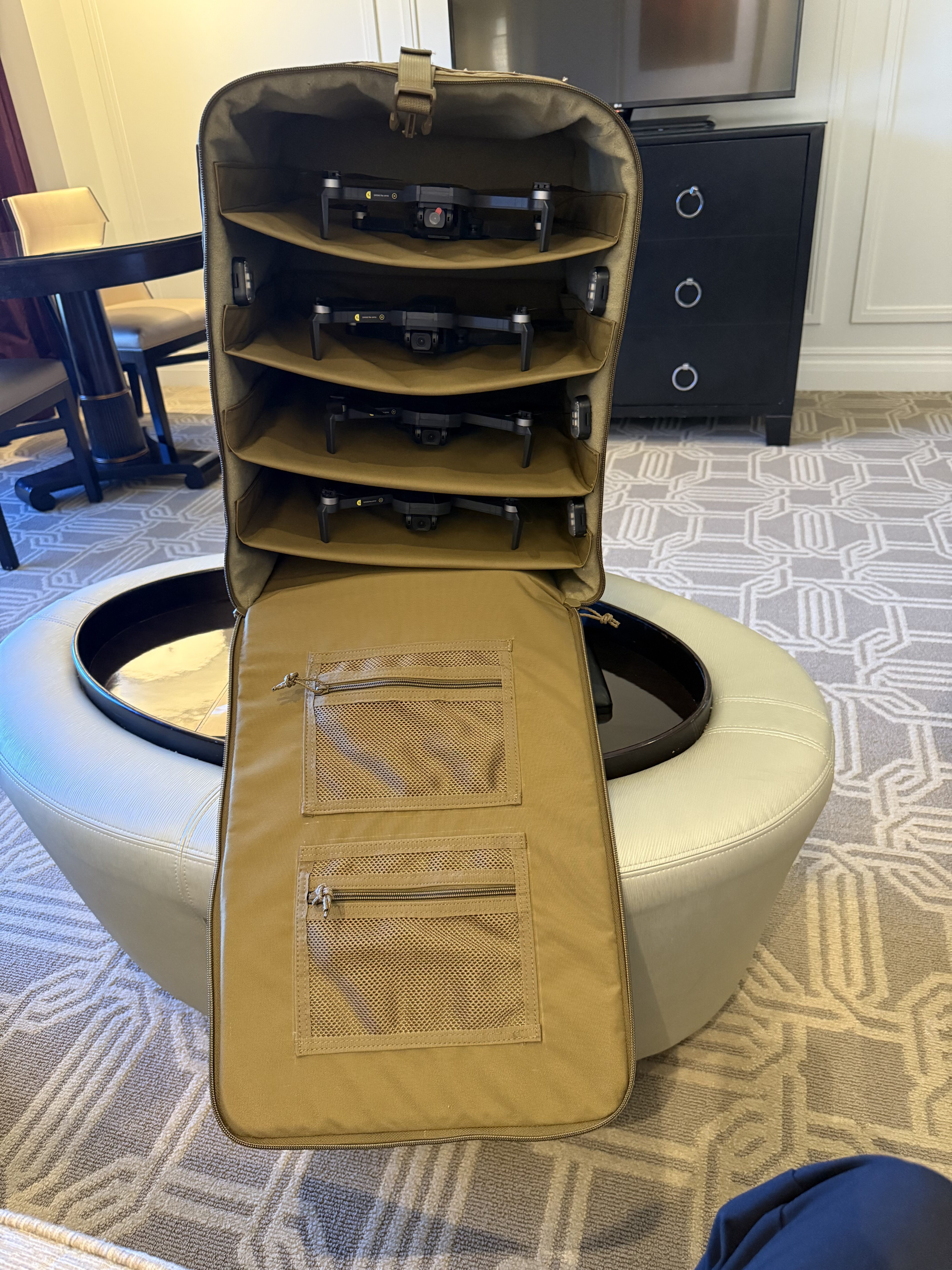
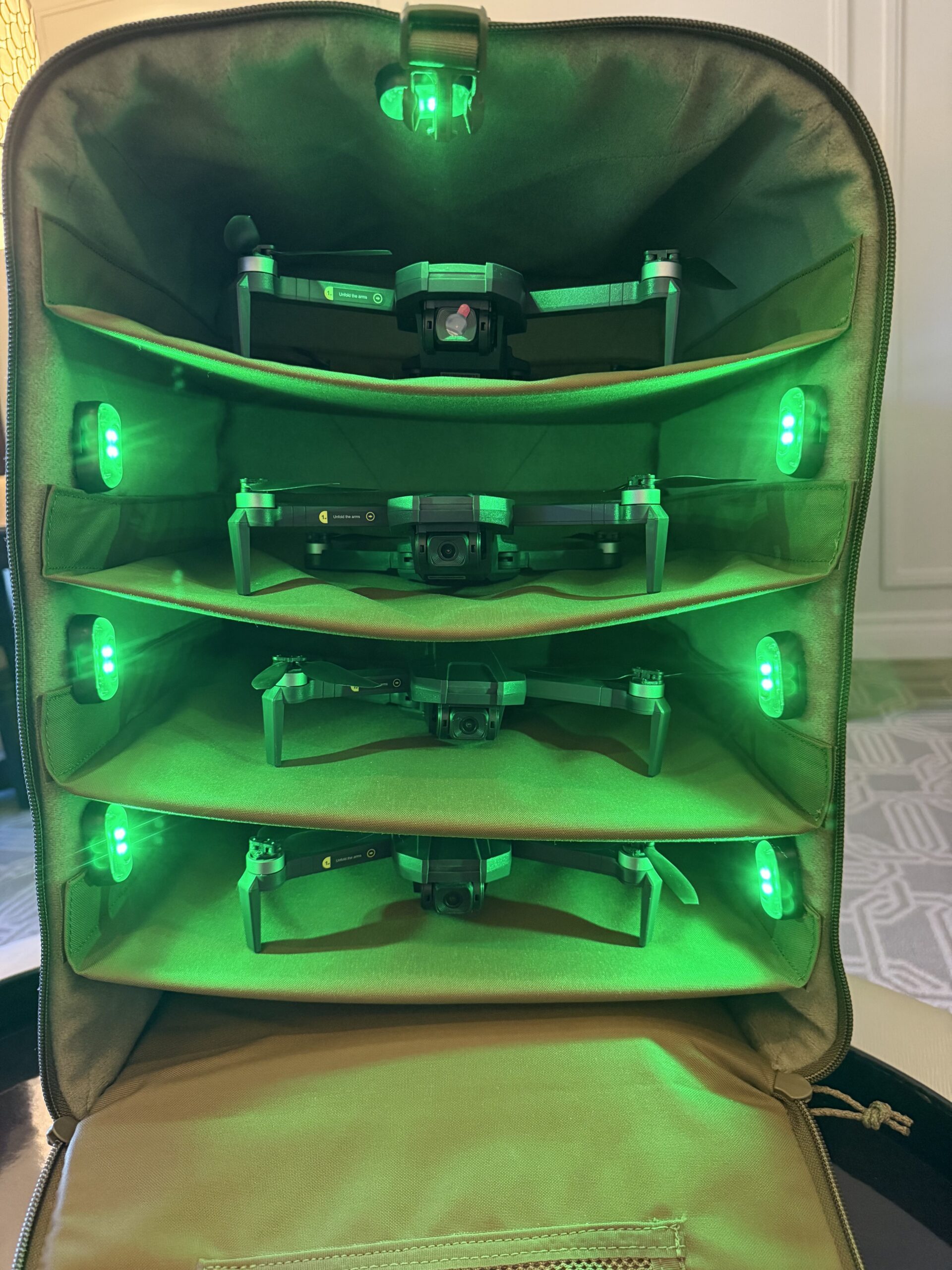
Working collaboratively with emerging high-technology drone developers, our team developed the Quick Deployment Drone Pack, a purpose-built carrying and deployment system that enables warfighters to transport, protect, rapidly deploy, retrieve, and securely store multi-mission unmanned aerial systems in demanding battlefield environments.
The challenge was not simply to create another backpack. The objective was to engineer a mobile protective system around the operational requirements of the drone itself—protecting sensitive equipment while minimizing deployment time and maximizing the warfighter's mobility.
The resulting pack bridges the gap between advanced drone technology and battlefield practicality, demonstrating how engineered textile products can become an enabling technology for next-generation defense systems.
Project Complexity
The Drone Pack required a combination of textile engineering, structural reinforcement, protective materials, ergonomic design, and field-oriented problem solving. The system had to meet several competing requirements:
• Single-person mobility: Lightweight and manageable enough for one warfighter to transport without significantly restricting movement.
• Rapid deployment: Designed for quick access to drones when seconds matter, while also allowing efficient retrieval and repacking.
• Protection of sensitive technology: The pack had to protect sophisticated drone systems from puncture, abrasion, impact, contamination, and rough handling.
• Environmental resistance: Hydrophobic construction and durable materials help protect contents from moisture and challenging environmental conditions, including extreme temperatures.
• Secure storage: The system incorporates secure closures and construction intended to deter unauthorized access and protect mission-critical equipment.
• Structural stability: Reinforcement was incorporated to maintain pack integrity while protecting the shape and contents of the system during transport.
• Cost effectiveness: The design had to provide meaningful battlefield capability without adding unnecessary complexity or cost.
• Adaptability: The system needed to accommodate evolving drone configurations and the rapidly changing requirements of the unmanned systems market.
Textile Engineering & Materials
The Drone Pack combines multiple engineered textile and structural materials selected for specific performance requirements:
• 1000-denier nylon with urethane backing for a durable, water-resistant primary exterior.
• Double-layer laminated nylon for structural durability.
• Closed-cell foam for cushioning and protection of sensitive drone components.
• High-strength nylon webbing for load management, reinforcement, and secure attachment.
• HDPE reinforcement to provide rigidity and dimensional stability where required.
• Abrasion-resistant zipper closures designed for repeated use in demanding field conditions.
The materials were integrated into a purpose-built cut-and-sew assembly rather than simply adapted from a conventional backpack design. This allowed the construction, reinforcement, protection, and access features to be engineered around the operational requirements of unmanned systems.
Project Results
The result is a cost-effective, mission-focused deployment system delivered on schedule and under budget.
The Quick Deployment Drone Pack gives a warfighter the ability to carry drone assets into the operational environment, rapidly deploy them, retrieve them, and protect them for subsequent missions. The system is particularly suited to operations involving multiple small unmanned systems, including swarm-drone concepts in which numerous drones can work together to expand battlefield awareness and accelerate response.
Beyond the individual product, the project demonstrates a broader capability: advanced textile manufacturing can directly enable emerging defense technologies.
As the military rapidly adopts autonomous and unmanned systems, the supporting equipment must evolve just as quickly. The Quick Deployment Drone Pack illustrates how an engineered textile solution can transform a highly capable but fragile piece of technology into a practical, mobile, field-ready battlefield asset.
This project represents the convergence of textile engineering, advanced materials, rapid product development, and modern military requirements—proving that the right textile solution can be just as important to mission success as the technology it protects.
Relevant Articles:
• Everyone is Learning the Wrong Lessons from Ukraine’s Drone War by Kathleen J. McInnis, Breaking Defense, 8/5/2026
• Drones Have Changed the Battlefield by Roger N. McDermott, Modern War Institute, 8/1326
Content is submitted by the participant. ATA is not responsible for the content descriptions of the IAA award winners.
Mike Runella (Ehmke Manufacturing Company, Inc.)
Mike Runella (Ehmke Manufacturing Company, Inc.)