TEXTILES.ORG



Company:
ACD Group / All Weather Solutions
Project Details
Fabric 1
clear PVC
Producer/Manufacturer:
TopFab Ltd
Primary Use:
Secondary Fabric
Fabric 2
mesh
Producer/Manufacturer:
Shann NZ Ltd
Primary Use:
Main Fabric
Fabric 3
Sundream Charcoal
Producer/Manufacturer:
W Wiggins Ltd
Primary Use:
Main Fabric
Please describe the project specifications
Our client asked us to install some outdoor blinds (screens) on their newly installed louvre canopy.
They have 4 gaps needed screens but they have very complicated requirements. Below is a summary of their requirements:
Slim-line design - screens must fit within the framework of the louvre canopy, and maximize height when rolled up.
Weather proof - screens need to provide full protection from wind and rain
Shade - Screens need to provide shade from the afternoon sun
Privacy - Screens have to block out from neighbour and street
Easy of use - Elderly people need to be able to operate the screens easily. Some of the blinds need to be motorised.
What is unique or complex about the project?
To full-fill all the requirements, we have decided to do a due-layer design for each gap. This means we have to fit two blinds within each gap.
We also choose 3 different fabrics to achieve weather protection, privacy (full-block out), and shade (partcial block out). But we can only use 2 fabrics on each gap. So ended up use different fabric combinations for each gap. here is a summary:
Gap one and Gap two (blidnd 1 2 3 & 4): Sundream on the outside and black mesh on the inside. The black mesh on the inside provided shade and some level of privacy from neighboring property. the Sundream charcoal fabric provided full block (of wind and rain) while allowed some light pass through. Inner mesh screen were down most of the time and outter sundream screen only needed when weather protection is needed.
Gap three and four (blind 5,6,7&8): Clear PVC on the outside and black mesh on the inside. The black mesh on the inside provided shade and certain level of privacy. The clear PVC on the outside provided full protection from wind and rain. Outside blinds were down most of the time to allow sunlight come into the pergola and stop wind. Mesh blinds were used when they needed shade and privacy.
This client also wanted to have at least one screen motorised for each gap for ease of operation. For two of the gap they wanted to have the motorised screen on the outside layer and they other two gap they wanted the motorised screen to be on the inside. this made the design a challange.
The complicated requirements gave us a few design challanges:
1. All blinds need to be operated from inside - this meant we couldn't do face-mount and have the outside layer facing outwards.
2. We needed to fit two roller tubes in small head space - no supplier on the market had double roller blind system
3. manufacture challenges: we needed to carefully match the correct fabric with the correct blind component. And also cutting the correct component to corrent length (especially roller tube and bottom bar). This seemed easy but there were too many combinations.
The biggest challange for us was to fit two track-guided blinds and use minimum head space, so when both blind are up, there are still plenty of height under the blind.
we looked at all the products on the market and we didnt find any product could help us achieve this.
So we designed and folded our own brackets. Our brackets were 100mm in height, which was smaller than common bracket on the market (135mm bracket). This allowed us to mount roller tube closer and hence significantly reduced space.
we also found that current splins on the ziptrak were too bulky when they rolled up. We would loose a lot of head space if we put two ziptrak screens one below another.
We experimented with a few different alternatives and we found a special T-zip we can use. It was very flexible and so it did not take much space when the blind were rolled up.
it also fit inside the Ziptrak track so we can use the Ziptrak components.
The new T-zip did not fit onto our welding machine. so we 3-D printed a special jig to help us weld the zip onto the fabric.
End Result:
With all the custom design work, we managed to fit two roller tube with space less than 170mm. and there were plenty of clearence between the two roller. this allow us to cover both roller tube with a 170mm flashing. This was eqivlent to fitting two blinds into one large Ziptrak pelmet.
Our custom folded bracket also allowed us to swap motor side without needing to swap the motor adaptor. This hence made us change the wiring on site a lot easier.
Content is submitted by the participant. ATA is not responsible for the content descriptions of the IAA award winners.
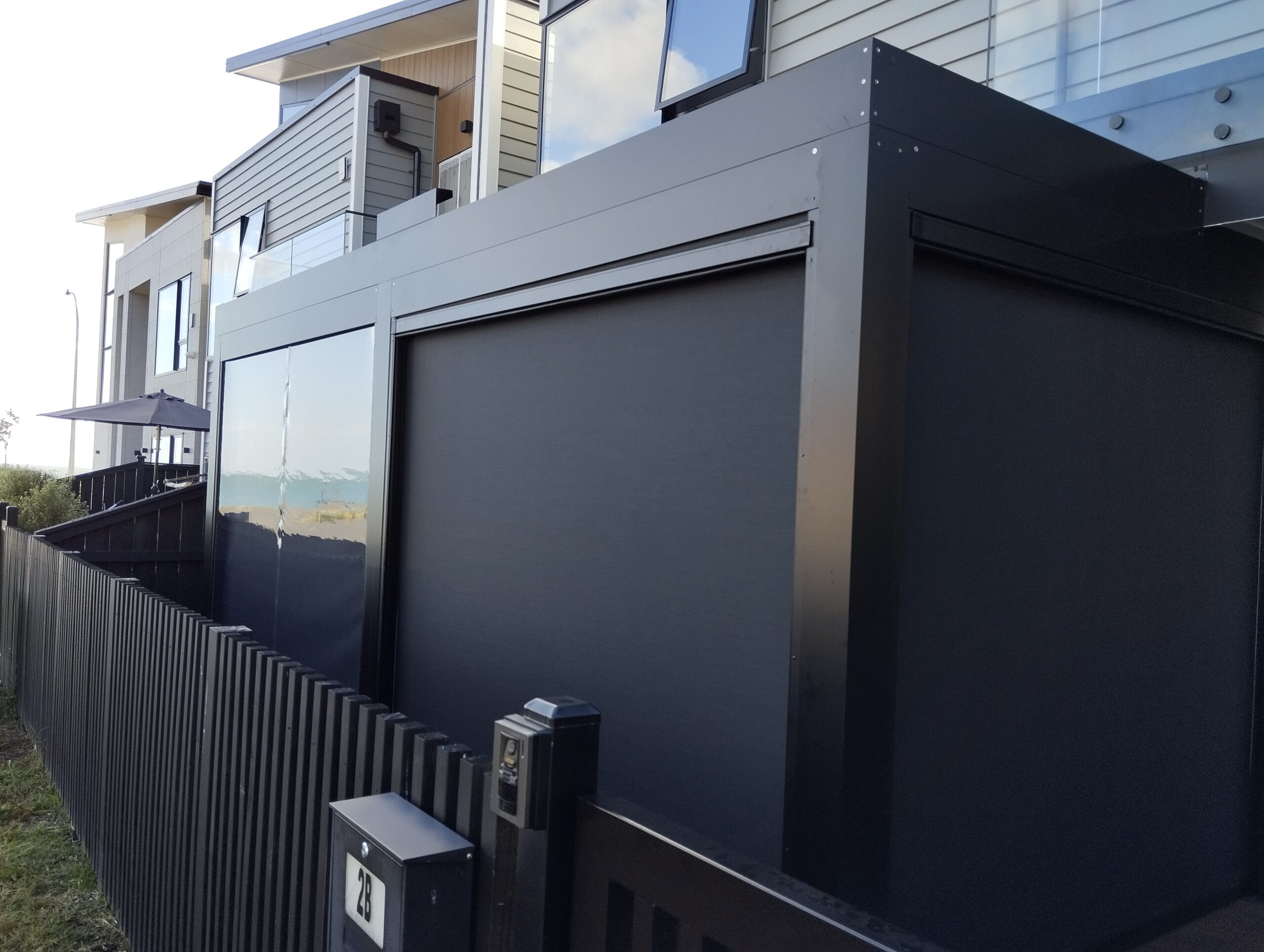
overview of the blinds