TEXTILES.ORG



Company:
Transformit
Project Details
Fabric 1
Acrobat
Producer/Manufacturer:
Dazian LLC
Primary Use:
Main Fabric
Fabric 2
Symmetry
Producer/Manufacturer:
Fisher Textiles
Primary Use:
Main Fabric
Engineer Company 1
Gulf of Maine EcoArts
Design Company
Gulf of Maine EcoArts
Fabrication Company
Gulf of Maine EcoArts
Subcontractor Company
Transformit
Graphics Company
Printed Ink
Project Manager Name
Anna Dibble
Project Manager Company
Gulf of Maine EcoArts
Installation Company
Gulf of Maine EcoArts
Please describe the project specifications
A new exhibit at the Maine Maritime Museum takes an artistic approach to climate and ecological activism. On display in the heart of Maine’s lobster fishery, the work is intended to stir things up.
Cashes Ledge, an undersea mountain in the Gulf of Maine, has an unusual abundance of sea life, but is under threat because the overfished Gulf is warming faster than 90% of the world's oceans. Gulf of Maine EcoArts, through this exhibit, is campaigning for permanent protection of Cashes Ledge. The idea: by protecting a series of smaller "nurseries", the entire Gulf of Maine fishery can be made more productive and more sustainable.
The initial project, entitled “Majestic Fragility”, was installed in the atrium of the Bigelow Laboratory for Ocean Sciences. For the fifteen months it was there, it received enthusiastic reviews, but few visitors from outside the research facility’s regular traffic.
It reopened in January of 2023, updated and expanded, as “Sea Change: Darkness and Light in the Gulf of Maine”, at the Maine Maritime Museum in Bath.
With inspiration from Red Grimes’s “Ruckus Manhattan” and a Codfish funeral staged by 350 Maine, Anna chose a collaborative, consensus decision making approach to address the climate crisis with art action. As a painter, she works alone; for this, she “curated” a diverse and complementary group of artists, now called Gulf of Maine EcoArts.
In addition to the core group of seven artists, more than a dozen schools, sixteen teachers and over two hundred students participated in the making of these installations, despite Covid interruptions.
Anna Dibble writes, "The entire way we decided to tell the ‘story’ and get across the ‘message’ was via the medium of art. Art explains the often dry and cryptic science - because people respond to art emotionally, not intellectually. Even the scientists admit it: “We’re boring!””
As a sculptor and business owner, I was asked to help execute the project, because my team has expertise in installations that transform environments, and because our stock of rental fabric structures solved some design challenges without a lot of money. While this project is not primarily a textile installation, it is perfectly aligned with the purpose of my business.
Take a walk through the exhibit (by Anna Dibble):
The Past:
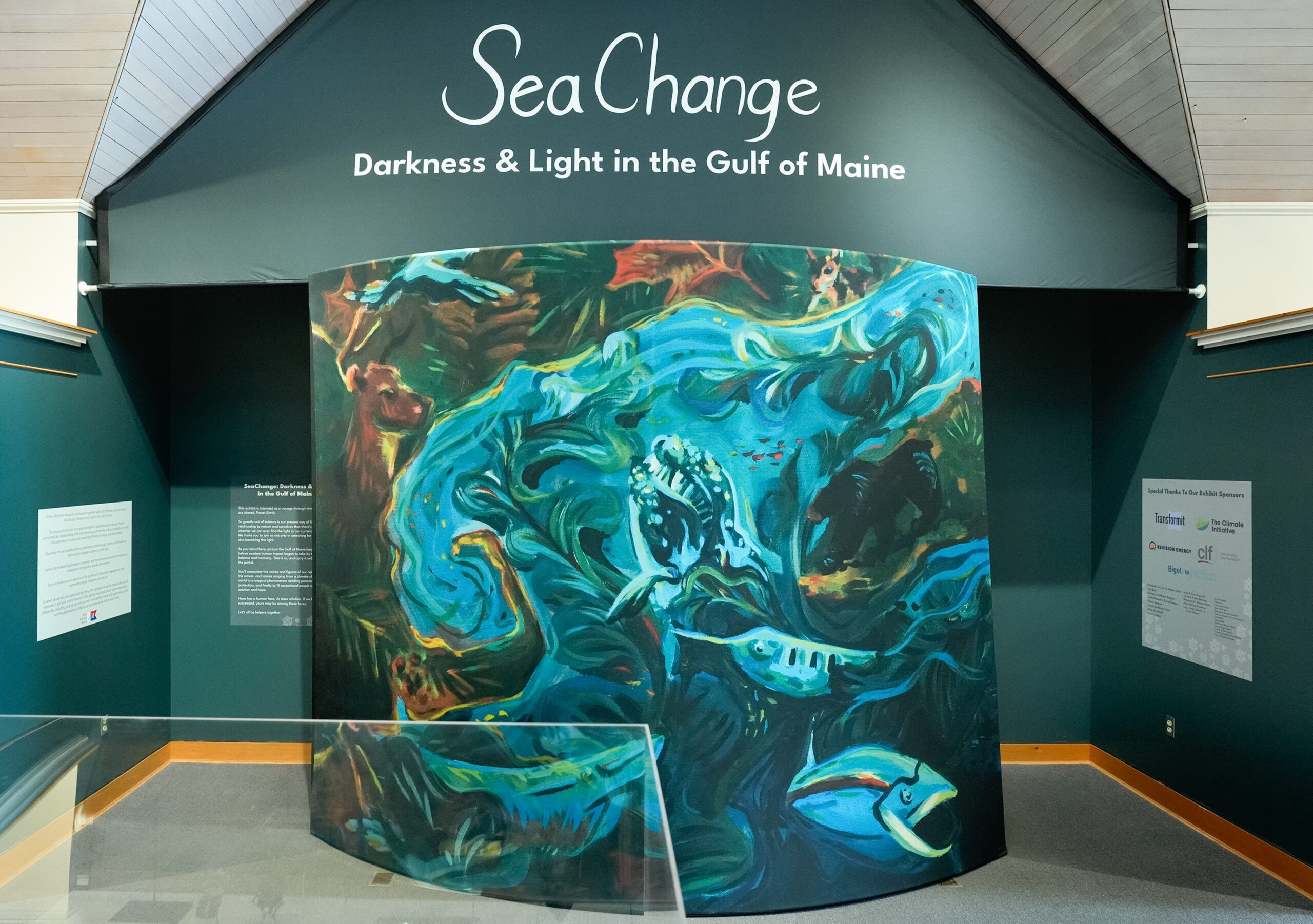
The exhibit begins in the pre-colonial Gulf of Maine when the water and land supported an abundance of wild animals and plant life.
The Art: A curved fabric wall printed with an undersea painting by Colby College student Viva Goetze
The Present: Dark:
Alienation from the natural world, forgetful of the past and heedless of the future, where greed, served by technology, has outpaced our ideals.
The Art: Suspended sculpture of a North Atlantic Right whale skeleton, entangled in fishing and lobster lines; black and white panels illustrating the climate crisis.
The Present: Light:
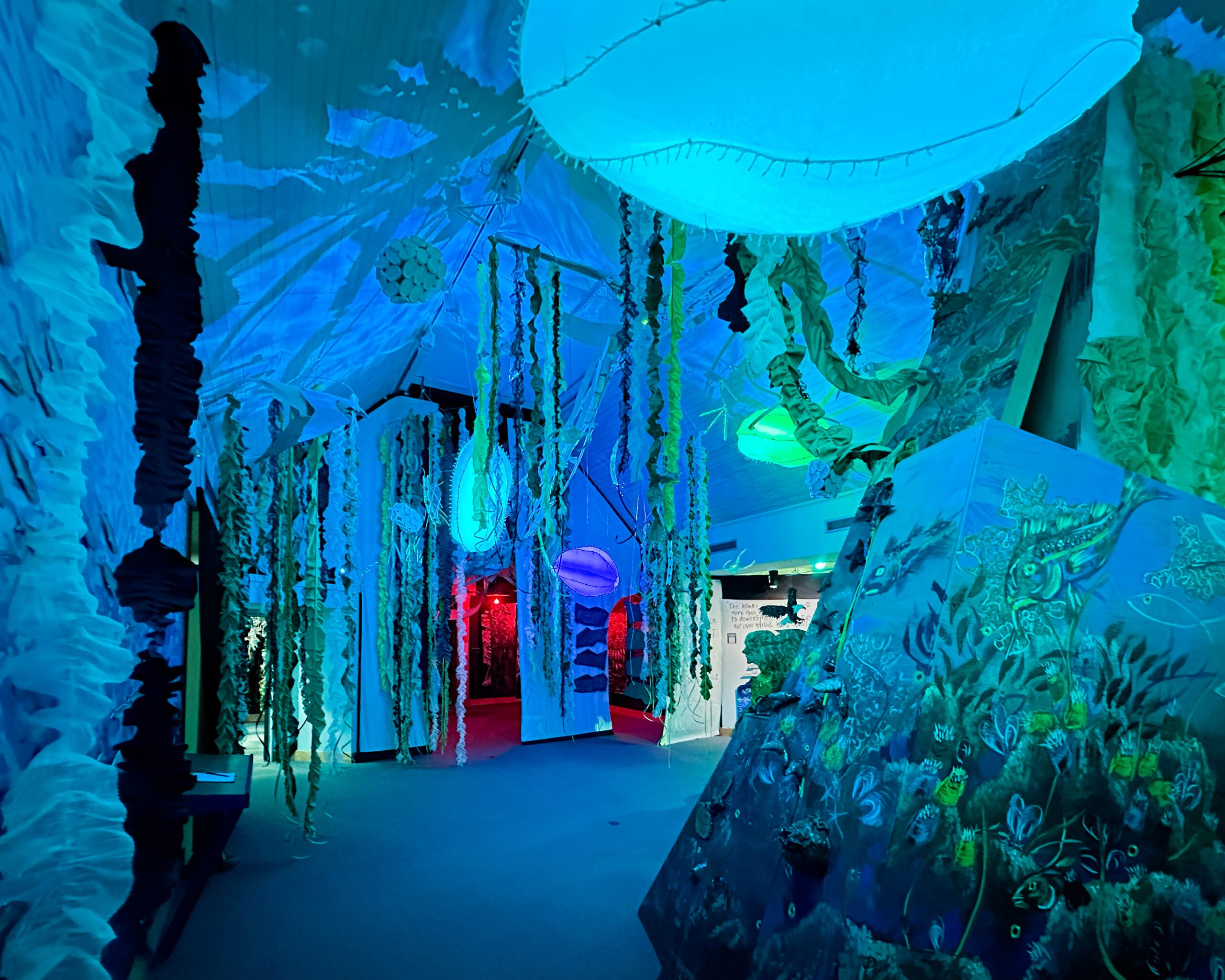
Cashes Ledge contains the largest and deepest continuous kelp forest in the waters of the eastern US. The topography and currents around the ledge create a unique environment where nutrient and oxygen-rich waters mix while being exposed to sunlight. This creates a healthy biodiversity system.
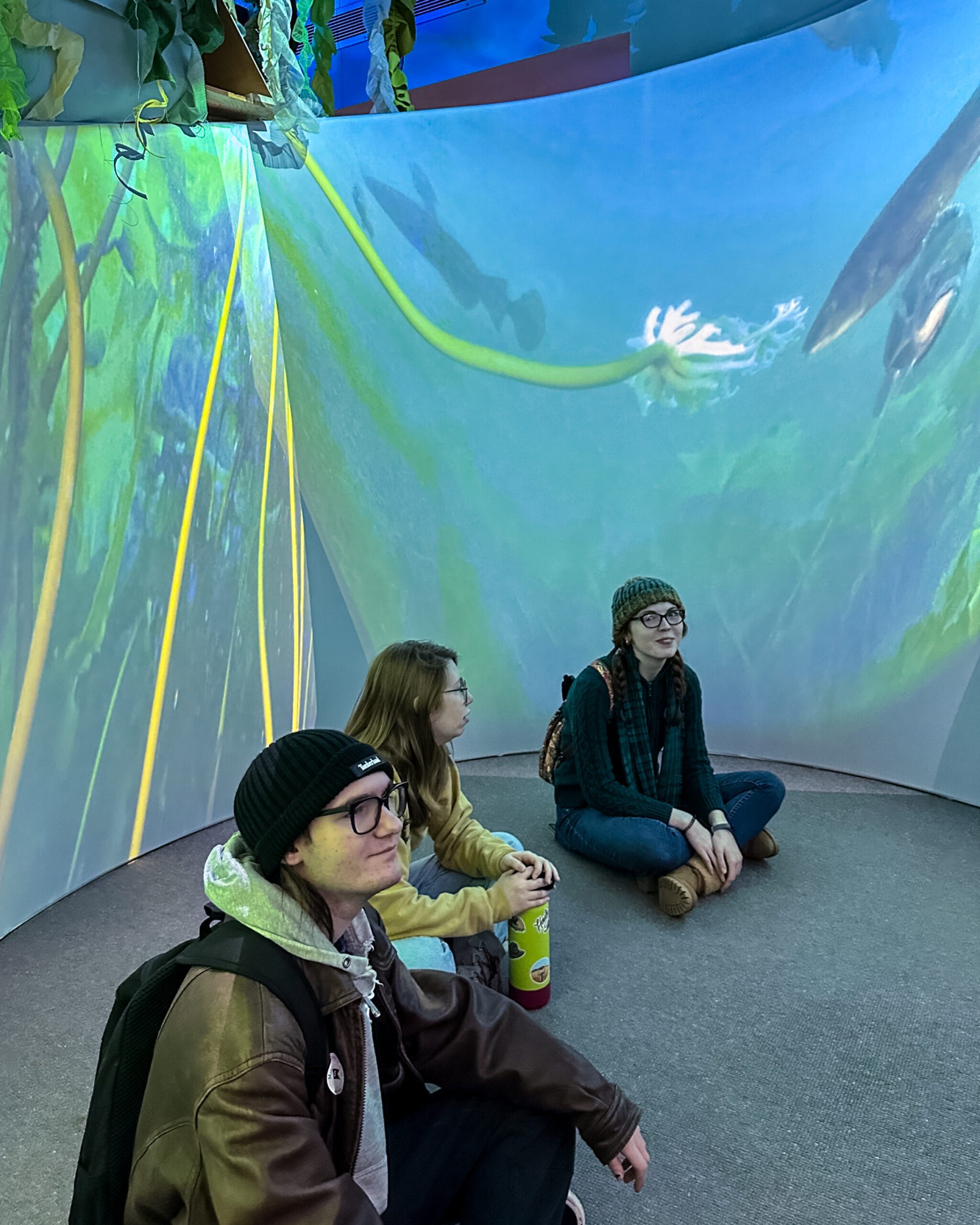
Immersive Projections: Behind Ammen Rock – A spiral-shaped fabric sculpture visitors can enter to experience actual footage from Conservation Law Foundation shot by National Geographic photographer Brian Skerry’s videographers during the last dives at Cashes Ledge.
Permanently Preserve Cashes Ledge: Area by the Herring wall where visitors can sign a petition supporting the Conservation Law Foundation's effort to preserve Cashes Ledge – as part of the international 30 by 30 initiative.
The Art: Soundscape – actual sonophone sounds of Gulf of Maine Marine life digitally mixed with music of environmentally-based Halcyon String Quartet. Our symbol of Cashes Ledge is a kelp forest, made by a team of Bigelow Lab donors; a replica of Ammen Rock, the highest peak in the Cashes’ mountain range – painted by a young art student; 3D ceramic raku-fired marine life; the Herring wall.
The Future:
Hall of Heroes: The Protectors: Eighteen individuals from all over the planet who are working toward mitigation, solution, and adaptation. They represent millions more, and act as inspiration for young environmental pioneers.
The Art: Portrait paintings, hand-lettered quotations, a sculptural paneled ‘screen’ with Ammen Rock painting continued on kelp forest side. Cut out, painted plywood sculpture.
The EcoLab:
A ‘makers table’ where visitors young and old can create sea creatures to hang from above, a microscope where microscopic animals and plants can be viewed, and information about Cashes Ledge, Bigelow Lab, plankton, and other elements of the exhibit.
Other notes:
All of the work is by volunteers, except the college intern artists, who were paid. All artistic, financial and practical decisions were made by consensus. Covid impacted the project severely, as much of the group's work involved school children. This is a community project in which the community made the art, and the art made the community!
The exhibit was scheduled to be on view through the end of 2023, but has found a new and very appropriate home at Wabanaki Public Health and Wellness, in Bangor, Maine, which serves the Houlton Band of Maliseet Indians, the Aroostook Band of Micmacs, the Passamaquoddy Tribe at Indian Township, the Passamaquoddy Tribe at Pleasant Point, and the Penobscot Nation.
"The larger purpose for this project is to help people recognize that all life is interconnected, and that the human species is a part of what some cultures call the ’natural world’, and not superior to, or separate from, plankton, ferns, whales and every other living thing."
Content is submitted by the participant. ATA is not responsible for the content descriptions of the IAA award winners.
Gregory Rec/ Portland Press Herald
Anna Dibble
Anna Dibble

Anna Dibble