TEXTILES.ORG



Company:
Global Synthetics
Project Details
Fabric 1
AceGrid
Producer/Manufacturer:
ACE Geosynthetics Inc.
Primary Use:
Main Fabric
Fabric 2
Pyramat
Producer/Manufacturer:
Propex Geosynthetics
Primary Use:
Additional Fabric
Design Company
Golder/WSP
Subcontractor Company
Global Synthetics
Project Manager Company
Cleanaway
Please describe the project specifications
Erskine Park Landfill airspace was forecasted to be exhausted late 2020. No other landfill assets were available in the NSW portfolio. Horizontal expansion was not an option, and conventional vertical expansion methods have been already applied. The landfill was situated at the site of an excavated volcanic diatreme in Western Sydney in Australia. Property boundaries constrain the lateral expansion of the landfill. The required design life was 100 years. A method was required which allowed the landfill to increase capacity and extend its operational life while under operation and without the need for closure, which was called 'live' expansion.
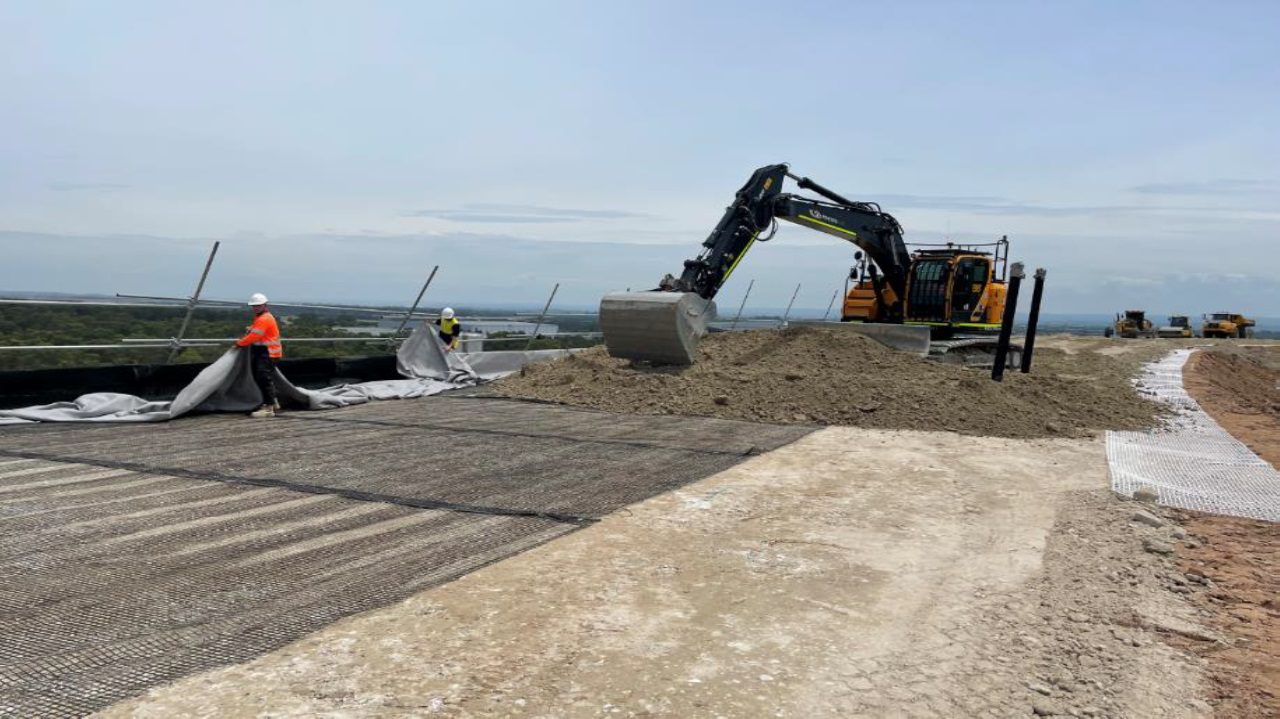
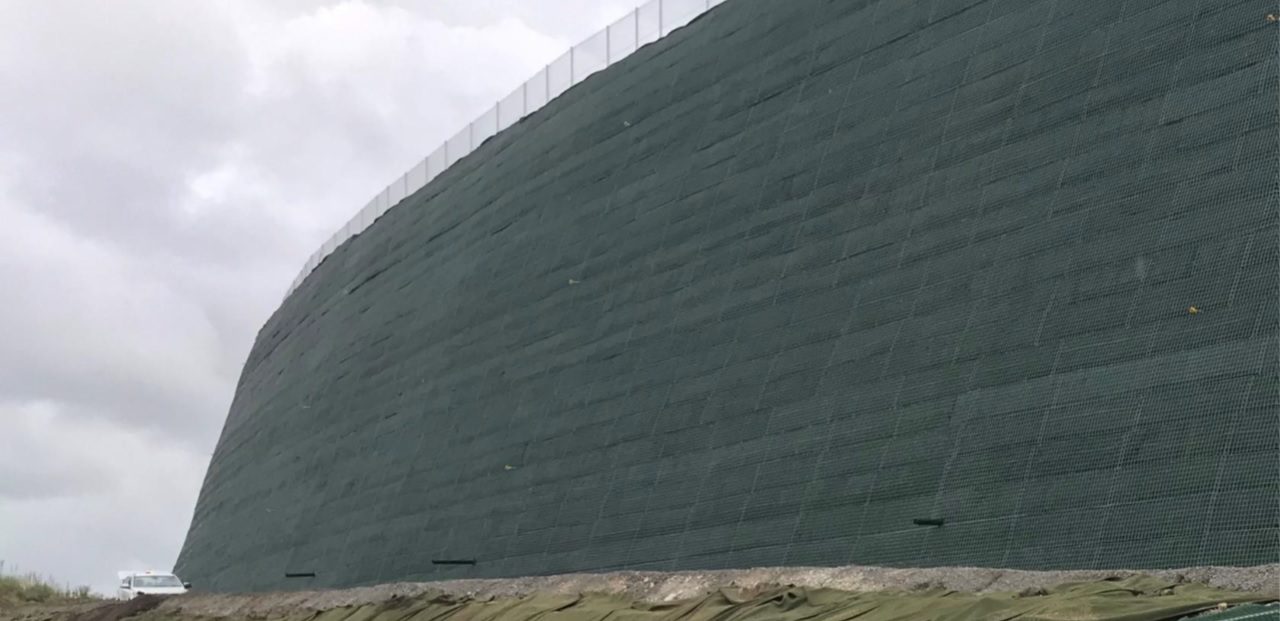
Following an optioneering assessment phase by designer, the Terralink® MSE wall system comprising AceGrid® uniaxial geogrid retaining wall with steel mesh facing was assessed to be feasible and economically viable to increase available airspace for waste placement. This method, which is distinct from piggybacking, involves the construction of a geogrid reinforced mechanically stabilised earth wall (MSE wall/berm), facilitating the expansion process during active landfill operations. From cost-benefit analysis, 16.5m was selected as the feasible height for the MSE wall.
Some design challenges:
The MSE wall system was not just a wall, but a complicated system including:
a. New lining system and connection details to the existing liners
b. New liner support fill
c. Top of wall features
d. MSE wall components and details
e. Foundation
f. Stormwater management
There were 3 existing retaining walls downstream around the existing site, just at the boundary of the landfill area, holding the soil and existing landfill site. Also property boundaries and a LFG pipe was passing just at the edge of the new MSE wall location. There was also a pond at the other edge of the new MSE wall location which needed to be maintained. Construction of the new MSE wall needed some extra checks including stability check of the existing retaining walls due to to extra load from the new MSE wall, keeping the pond operational and clean, avoid any effect on the exiting LFG pipe.
Due to the site boundaries, the foundation of the new MSE wall in some areas would be partially seating on old waste, which could cause differential settlements below the MSE wall, which needed to be checked and controlled.
Key design considerations:
Key design considerations for the MSE retaining wall included serviceability, settlement, design life and durability from exposure to adverse environments, foundation requirements, backfill quality requirements and construction costs. Apart from internal stability checks and settlement modellings, Six scenarios and checks were considered throughout the life of the structure for global failure:
Case 1 – End of MSE wall construction including construction loading.
Case 2 – End of landfill construction, with waste placed on the liner, design loading, long term GWL.
Case 3 – Long term loading with undrained parameters below GWL.
Case 4 – Long term loading with drained conditions.
Case 5 – Long term loading with extreme GWL conditions.
Case 6 – Earthquake loading.
Other considerations during the design included the durability of the structure and the visual appearance, given the scale of the structure. A high UV stabilised High Performance TRM (HPTRM) was used within the MSE wall at the facing behind the mesh, for additional long term durability requirements and geogrid protection as well as providing a green surface and appearance. Crushed rock was used behind the geogrid at the facing to provide surface drainage.
To cover both landfill operation and MSE wall construction requirements and allow for both happing at the same time and save time, the wall was designed and constructed in two stages, so the completed MSE wall section in stage 1 could go under operation and be added to the landfill capacity while the MSE wall in stage 2 was being built.
To account for foundation variability, the wall was designed to accommodate the compression and consolidation of the founding materials to ensure it functioned effectively supporting the landfill lining system and maintained its structural integrity. AceGrid® and Secugrid® biaxial geogrids were also used to stabilise the soil in some parts of the foundation.
The wall was instrumented in different locations for monitoring the horizontal and vertical movements and settlements.
Construction challenges:
- Regulatory Approvals
- Managing contaminations and sediments to keep the existing pond adjutant to the MSE wall clean and useable.
- Managing safety on site, as the wall was being built while the landfill was under operation and accepting waste simultaneously.
- Just few months after the construction started, COVID 19 pandemic started as well. The landfill operation and MSE wall construction had to be continued and managed with applying all the required health and safety and quarantine requirements.
- Two major flood events across 2021 & 2022 in Sydney during wall construction
- Adverse ground conditions
Features and Benefits:
Erskine Park Landfill’s live expansion, the first of its kind in Australia, features the country’s largest landfill application of MSE technology—900 meters in length and over 16.5 meters high. Overall, more than 400,000m2 of geogrid was used in the construction of the MSE wall system.
The project has set a new standard and precedent for the Australian landfill industry and opened up the opportunity to revitalise dormant assets or extend the life of assets heading towards closure, specially in a climate where fewer and fewer landfills are being approved. The MSE wall technology unlocked 430,000 cubic metres of airspace (about 774,000 tons of extra waste) that was previously not available. This extends the operational life of Erskine Park Landfill by over three years and alleviates some of the pressure on Sydney’s landfill network.
The Erskine Park Landfill in NSW, recognised as the “Great Wall of Sydney“, showcases a pioneering sustainable approach to landfill expansion known as live expansion. This technology and approach were in line with client's Blueprint 2030 strategy, Blueprint 4 – Landfill Optimisation, which focuses on investing in new capacity to ensure that there is sufficient airspace at the existing landfill operations.
For its innovative MSE wall project, this project was awarded the ‘Outstanding Innovation, Project or Facility’ award by Waste Management and Resource Recovery of Australia (WMRRA) at the 2023 Australian Landfill and Transfer Station Awards.
Content is submitted by the participant. ATA is not responsible for the content descriptions of the IAA award winners.

Global Synthetics
Cleanaway
Cleanaway

WSP